Micrographia: why handwriting gets smaller, and what helps
You start a line at your normal size. By the end, the letters have shrunk and crowded together. That's micrographia, and you can do more about it than most people are told.
By the CurvaPen team · Updated November 12, 2026
Micrographia means handwriting that is unusually small, or that gets smaller as you write. It's most often linked to Parkinson's. Visual targets, a deliberate "think big" habit, a steady arm, short practice sessions and a pen that lets you see each letter can all help keep letters bigger. Talk to your doctor or an occupational therapist about new changes.
What micrographia is
Micrographia is the medical name for small handwriting. It shows up two ways. Some people write small from the very first letter. Others start at their usual size and shrink as they go, so a sentence tapers off toward the end of the line. Words can also crowd closer together and get harder to read.
It's one of the most common writing changes in Parkinson's, and for some people it's one of the first things they notice, sometimes before a diagnosis. That's why a family member often spots it first, on a birthday card or a grocery list.
Why it happens
Parkinson's affects the brain's ability to keep movements big and automatic. Movements gradually get smaller and slower when you aren't consciously thinking about them. Handwriting is a long string of tiny automatic movements, so it's one of the first places this shows up. Stiff fingers and a tremor can add to it.
The useful part: because the problem is about movements running on autopilot, giving your brain something to aim at, like a line, a target size or a deliberate cue, often helps. Research on writing in Parkinson's keeps coming back to this idea of cueing.
Small handwriting can have other causes too. If your writing has changed and you don't know why, mention it to your doctor.
Seven habits that help keep letters bigger
- Think big, on purpose. Before each line, tell yourself "big letters." It sounds too simple, but a conscious cue is the core of many therapy programs for movement size.
- Give yourself a target. Wide-ruled paper, or draw two lines and aim for letters that touch both. Graph paper works too: one letter per box.
- Watch every letter form. Seeing the letter as you make it is feedback your brain uses to keep it big. If your hand or the pen hides the tip, you lose that.
- Anchor your arm. Forearm flat on the table, feet on the floor, paper straight in front of you. A steady base means steadier strokes.
- Keep the paper still. A clipboard, a non-slip mat, or a strip of tape stops the page from sliding away from you.
- Write in your "on" time. If you take medication, save cards, checks and forms for when it's working best.
- Short sessions, then rest. A few lines, a break, then a few more. Letters tend to shrink as the hand tires.
A simple warm-up routine
1 minute: big loops and circles across the whole page, as large as you can.
1 minute: rows of tall letters between two lines: l, h, k, b.
2 minutes: write your name and one short sentence, checking that the last word is as big as the first.
1 minute: rest, then write one real thing: a list, a note, a card.
An occupational therapist can build a routine around your own hands. Ask your doctor for a referral.
Where the pen fits in
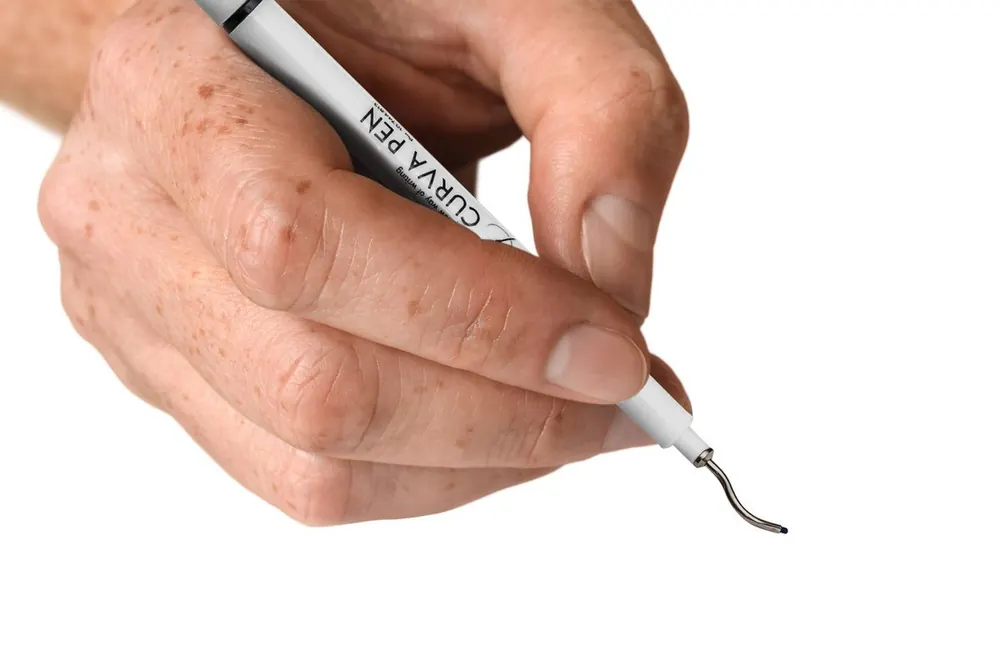
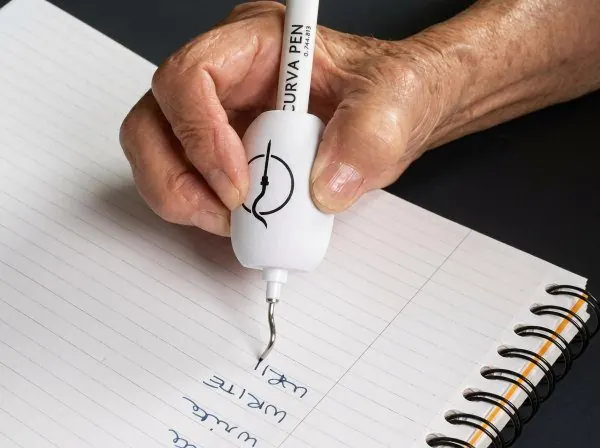
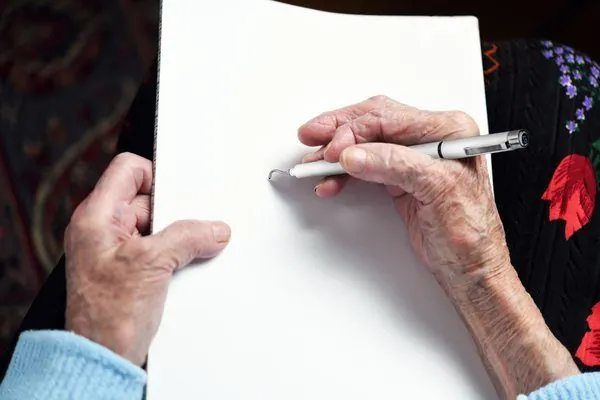
Most pens put your fingers right over the point, so you're writing half blind. CurvaPen's patented curved nib sits out in front of your fingers, so you can watch each letter as it forms and see right away if it's getting smaller. You can rest your hand on the page and let it be the steady base, and the 0.7mm Japanese tip glides with a light touch, so you don't have to press hard.
It won't cure micrographia, and no pen will. It just takes away one obstacle: not being able to see what you're writing.
Writing with Parkinson’s and hand tremors
See CurvaPen in action.
Light, not weighted, with the tip in view. 30-day refund.
Common questions
Is small handwriting always a sign of Parkinson's?
No. Micrographia is strongly linked to Parkinson's, but writing can change for other reasons too. If it's new or getting worse, talk to your doctor.
Can micrographia get better?
Many people find their letters stay bigger with cueing, practice and the right setup. How much it helps varies from person to person, and an occupational therapist can tailor a plan.
Should I use a weighted pen?
Some people find a weighted pen helps with tremor. Many find it tiring over a long note, and it doesn't solve seeing the tip. Here's how the two compare.
Does typing instead make it worse?
There's no harm in typing when you need to. If writing by hand matters to you, a few minutes of practice most days keeps the skill in use.
Sources and further reading: Parkinson's Foundation · American Parkinson Disease Association · research on micrographia and cueing. This guide is general information, not medical advice. CurvaPen is not a medical device.